
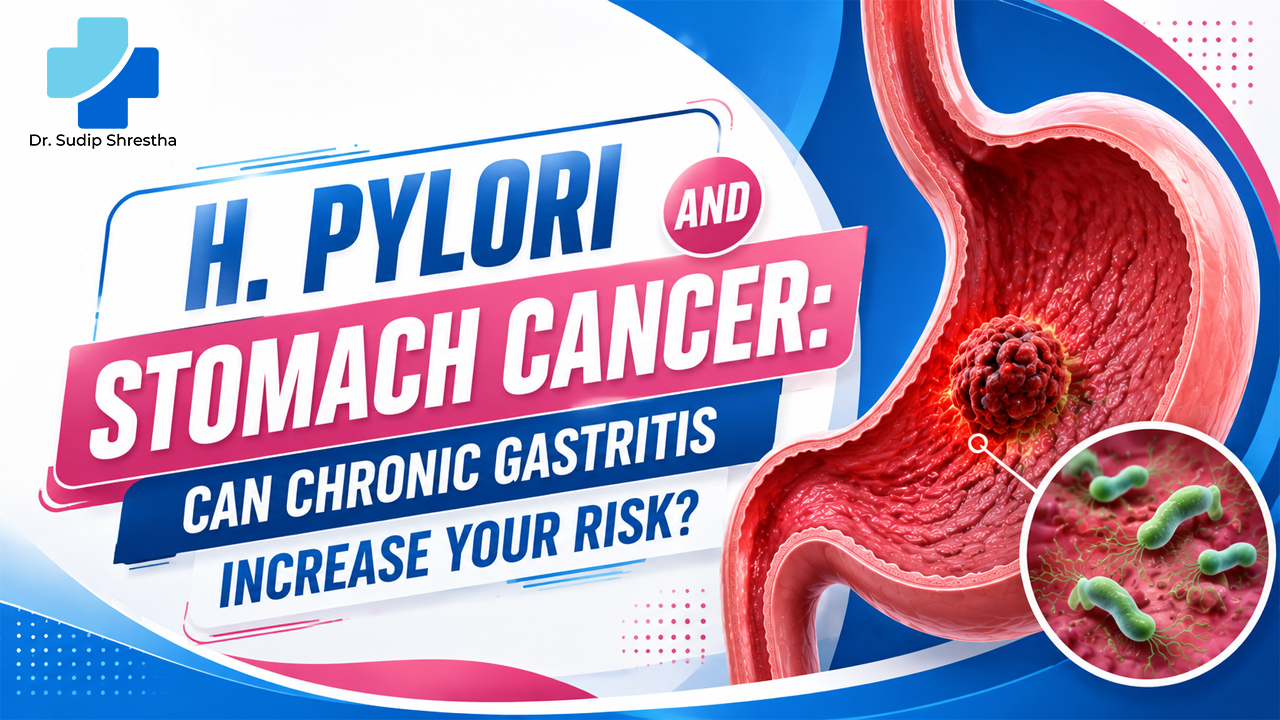
H. pylori and stomach cancer are strongly connected, but the relationship is often misunderstood. Chronic infection with Helicobacter pylori can cause long-lasting inflammation of the stomach lining and is an important cause of non-cardia gastric cancer. However, having H. pylori or gastritis does not mean that a person will automatically develop cancer.
The frequently repeated “90%” figure also needs context. An International Agency for Research on Cancer analysis estimated that about 89% of non-cardia gastric cancers worldwide were attributable to H. pylori infection. This does not mean H. pylori causes 90% of all cancers, or that 90% of people infected with the bacterium will develop stomach cancer.
Understanding this distinction can help people with recurrent gastritis or a confirmed H. pylori infection take appropriate action without unnecessary fear.
What Is H. pylori and How Does It Affect the Stomach?
Helicobacter pylori, usually shortened to H. pylori, is a bacterium that can colonize the stomach lining. H. pylori infection is one of the most common causes of chronic gastritis. Many infected people have no obvious symptoms, while others experience indigestion, abdominal discomfort, nausea, ulcers or other gastric problems.
Chronic H. pylori infection causes persistent inflammation in the stomach. In some people, that inflammation remains relatively limited. In others, years of inflammation can lead to structural changes in the stomach lining that are associated with a greater risk of gastric cancer.
H. pylori has been classified as a human carcinogen because of its established relationship with gastric adenocarcinoma and gastric MALT lymphoma.
This makes H. pylori important not only to gastroenterology but also to cancer prevention.
What Does the “89% of Stomach Cancer” Statistic Actually Mean?
The number is frequently quoted incorrectly.
An IARC analysis examining the worldwide cancer burden estimated that 89% of non-cardia gastric cancers were attributable to H. pylori infection. Non-cardia gastric cancer develops in the main part of the stomach rather than the area immediately adjacent to the esophagus.
The denominator matters.
| Statement | Is it accurate? | Correct interpretation |
|---|---|---|
| “H. pylori causes 90% of all cancers.” | No | Cancer has many causes and risk factors. |
| “90% of people with H. pylori get stomach cancer.” | No | Most infected people do not develop gastric cancer. |
| “Gastritis causes 90% of cancer.” | No | Gastritis has different causes and does not automatically progress to cancer. |
| “Around 89% of non-cardia gastric cancers were attributable to H. pylori in an IARC global analysis.” | Yes | This is the population-level estimate being referenced. |
The original IARC analysis was based on global cancer burden estimates from 2008, so it should also be presented with that historical context rather than as a newly measured 2026 percentage.
The practical message is still important: H. pylori is one of the most significant preventable causes of gastric cancer, but individual cancer risk depends on much more than simply testing positive for the infection.
How Can H. pylori Gastritis Progress Toward Stomach Cancer?
Cancer does not usually appear immediately after H. pylori infection.
The concern is persistent inflammation over a long period. NCI describes chronic H. pylori infection as causing long-lasting gastritis in most infected people. In some individuals, this may progress to atrophic gastritis, in which the stomach lining becomes thinner and damaged.
The pathway may broadly be understood as:
H. pylori infection → chronic inflammation → atrophic gastritis → intestinal metaplasia → dysplastic changes → gastric cancer in some patients
This sequence is a risk pathway, not a guaranteed outcome.
Atrophic gastritis and gastric intestinal metaplasia are particularly important because NCI recognizes both as conditions associated with an increased risk of stomach cancer.
This is why simply asking, “Do I have gastritis?” is sometimes less useful than determining what type of gastritis is present, what caused it, and whether the stomach lining has undergone significant long-term changes.
Does Having Gastritis Mean You Will Develop Cancer?
No.
“Gastritis” simply describes inflammation of the stomach lining. It can have different causes. H. pylori infection is an important cause, but gastritis and stomach cancer are not the same disease.
Many people with gastritis never develop cancer.
The concern rises particularly when there is long-standing H. pylori infection associated with atrophic changes, intestinal metaplasia or other recognised gastric-cancer risk factors.
A useful clinical distinction is therefore:
| Condition | What it means | Cancer relevance |
|---|---|---|
| Acute or uncomplicated gastritis | Inflammation of stomach lining | Does not mean cancer |
| H. pylori gastritis | Chronic infection-related inflammation | Can increase long-term gastric-cancer risk |
| Atrophic gastritis | Loss/thinning of normal gastric lining | Recognised risk condition |
| Gastric intestinal metaplasia | Gastric cells replaced by intestinal-type cells | Associated with increased gastric-cancer risk |
| Gastric cancer | Malignant growth in stomach tissue | Requires cancer-specific diagnosis and treatment |
This distinction can prevent two common mistakes: ignoring persistent symptoms because they are assumed to be “just gastritis,” or becoming unnecessarily frightened because a routine gastritis diagnosis is mistaken for cancer.
What Symptoms Can H. pylori Gastritis Cause?
Many people with gastritis have no symptoms. When symptoms occur, NIDDK lists problems such as upper-abdominal discomfort, nausea, vomiting, early fullness, excessive fullness after eating and reduced appetite.
These symptoms are not specific to cancer.
Stomach cancer can also produce vague symptoms such as indigestion, stomach discomfort, bloating after eating, mild nausea, loss of appetite or heartburn. This overlap is one reason symptoms alone cannot reliably distinguish benign gastritis from gastric cancer.
Persistent or changing symptoms deserve more attention than an isolated episode of indigestion.
Dr. Sudip Shrestha’s existing guidance on early signs of cancer also emphasizes the importance of investigating persistent and unexplained changes rather than trying to diagnose cancer from a single symptom.
Which Stomach Symptoms Should Not Be Ignored?
Medical evaluation becomes particularly important when symptoms are persistent, progressive or accompanied by warning features.
Examples include unexplained weight loss, persistent vomiting, worsening stomach pain, difficulty swallowing, reduced appetite or evidence of gastrointestinal bleeding. NCI lists blood in the stool, vomiting, unexplained weight loss and stomach pain among possible symptoms of more advanced stomach cancer.
Black or tarry stool, red blood in vomit or vomit resembling coffee grounds can indicate bleeding in the stomach and require prompt medical attention.
These symptoms still do not prove that cancer is present. Ulcers, inflammation and other gastrointestinal conditions can cause similar problems. The purpose of medical assessment is to identify the cause.
Readers who want a broader overview can also review the website’s guidance on cancer warning signs.
How Is H. pylori Diagnosed?
Doctors can investigate H. pylori using several methods.
Common approaches include a urea breath test, stool testing and testing of stomach tissue obtained during an upper gastrointestinal endoscopy. NIDDK lists stool testing and urea breath testing among methods used to identify H. pylori infection.
Endoscopy has a different advantage: it allows a clinician to examine the stomach lining directly and obtain biopsy samples when clinically necessary.
Not everyone with occasional gastritis symptoms requires an endoscopy. Whether one is appropriate depends on factors such as symptoms, age, medical history, previous treatment, family history and concerning findings. That decision should be individualized by a qualified clinician rather than made from an online symptom checklist.
If H. pylori Is Found, Why Does Eradication Matter?
Treating confirmed H. pylori infection can do more than relieve gastric disease it can also reduce future gastric-cancer risk.
NCI reports evidence that eradication of H. pylori lowers gastric-cancer risk in several groups, including infected individuals and people at elevated risk.
A 2025 NCI gastric-cancer prevention review also reported evidence from randomized trials suggesting that eradication therapy reduces gastric-cancer incidence in high-risk populations.
Current American College of Gastroenterology guidance also emphasizes confirming that eradication has actually succeeded after treatment, using an appropriate follow-up test.
Treatment should be prescribed by a clinician. Antibiotic resistance has changed H. pylori management substantially, and international guidelines caution against automatically using certain older antibiotic combinations without considering susceptibility and current recommendations.
For that reason, people should not attempt to copy an antibiotic regimen from the internet or use leftover antibiotics.
Does Treating H. pylori Remove All Stomach-Cancer Risk?
No.
Eradication reduces risk, but it cannot guarantee that gastric cancer will never occur.
Risk may persist particularly when significant precancerous changes such as atrophic gastritis or intestinal metaplasia have already developed. Other risk factors can also remain present.
This is an important difference between risk reduction and risk elimination.
The goal of H. pylori management is therefore not to promise cancer prevention. It is to identify and treat an established carcinogenic infection appropriately and assess whether additional follow-up is warranted based on the individual’s gastric condition and overall risk.
For broader evidence-based prevention guidance, see cancer prevention strategies.
What Else Can Increase the Risk of Stomach Cancer?
H. pylori is a major risk factor, but it is not the only one.
NCI identifies additional factors associated with gastric-cancer risk, including chronic atrophic gastritis, gastric intestinal metaplasia, certain hereditary cancer syndromes, a first-degree relative with stomach cancer, tobacco use and diets high in salted, smoked or poorly preserved foods.
Risk therefore needs to be interpreted as a combination of factors rather than as a single yes-or-no result.
For example, a person with treated H. pylori and no significant gastric changes may have a very different risk profile from someone with persistent infection, intestinal metaplasia and a strong family history of gastric cancer.
That is why personalized medical assessment matters.
Why Does This Matter in Nepal?
Stomach cancer remains relevant to cancer care in Nepal. Dr. Sudip Shrestha’s website includes gastrointestinal cancers within its oncology treatment focus.
Timely evaluation is particularly important because delays in cancer diagnosis and treatment remain a challenge. A 2025 IARC report on the DECAN project found substantial delays across the care pathway among Nepalese patients with six common cancers, including stomach cancer. Across all cancers studied, the median interval from symptoms to treatment was 110 days.
That statistic does not mean every stomach-cancer patient waits 110 days. It does show why persistent symptoms should not be repeatedly dismissed without appropriate assessment.
Nepal-specific population-wide H. pylori screening recommendations should also not be inferred from recommendations designed for another country. IARC has developed global implementation guidance for population-based H. pylori screen-and-treat strategies, but implementation requires consideration of local disease burden, health-system readiness, antibiotic stewardship and cost-effectiveness.
When Is Specialist Cancer Care Appropriate?
Most people with ordinary gastritis do not need an oncologist.
Initial assessment may involve a primary-care doctor, physician or gastroenterology specialist who can investigate symptoms, test for H. pylori and determine whether endoscopy or biopsy is required.
Cancer-specialist evaluation becomes more relevant when there is a suspicious endoscopic finding, abnormal biopsy, confirmed gastric malignancy or another finding that raises concern for cancer.
Dr. Sudip Shrestha’s website lists GI cancer treatment alongside chemotherapy, immunotherapy and targeted therapy services. His verified profile identifies him as a Senior Consultant Medical Oncologist.
If a biopsy, endoscopy or scan has raised concern about gastric cancer, discussing the findings with an appropriate cancer-care team can help clarify diagnosis, staging and treatment options.
Key Takeaways
H. pylori is an important cause of chronic gastritis and one of the strongest established risk factors for non-cardia gastric cancer. But infection does not mean cancer is inevitable.
The often-repeated “90%” statement should be expressed accurately: an IARC analysis estimated that 89% of non-cardia gastric cancers were attributable to H. pylori, not that 90% of all cancers or gastritis cases become cancer.
Identifying H. pylori, treating confirmed infection appropriately, confirming eradication where recommended and investigating persistent or concerning gastric symptoms can all form part of evidence-based gastric-cancer risk management.
If investigations already suggest stomach cancer, patients can explore Dr. Sudip Shrestha’s oncology background or schedule a consultation to discuss appropriate next steps.
Medical disclaimer: This article is intended for general education. It cannot diagnose gastritis, H. pylori infection or stomach cancer and should not replace evaluation by a qualified healthcare professional.