
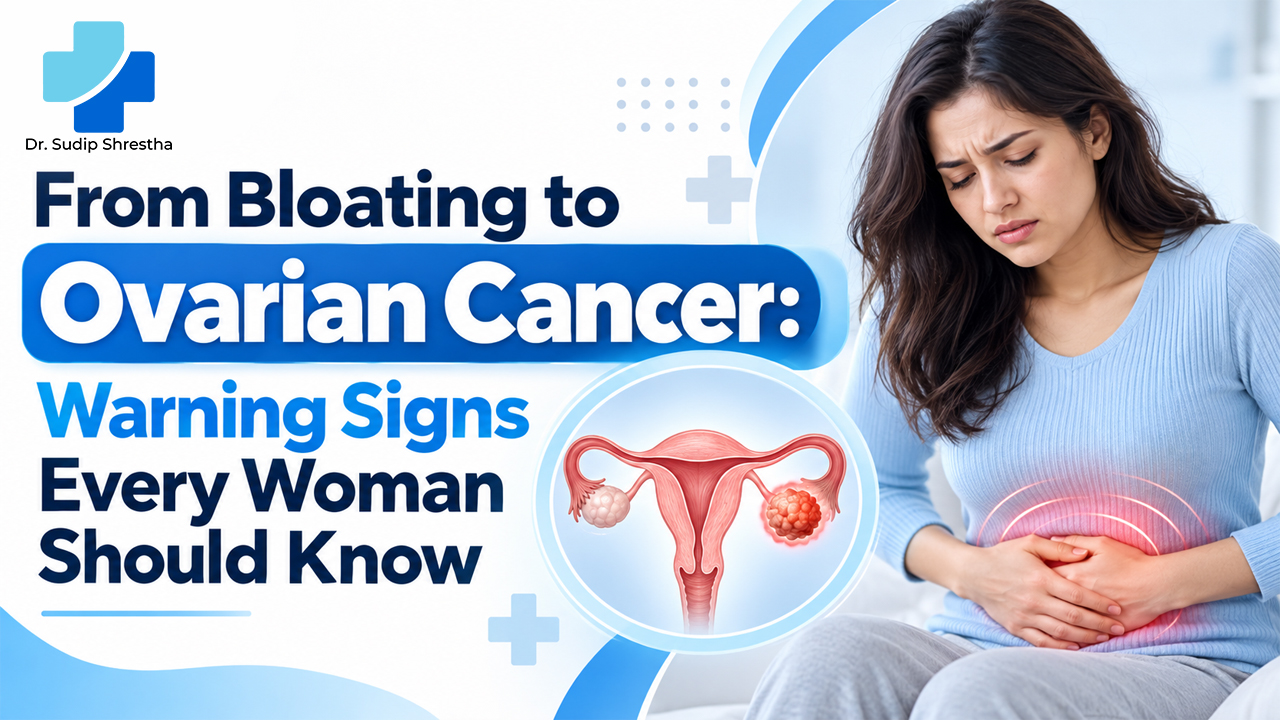
Bloating is extremely common, and having a bloated abdomen does not mean you have ovarian cancer. What deserves closer attention is bloating that is new or unusual for you, occurs frequently, persists instead of settling, becomes progressively worse, or appears together with symptoms such as pelvic or abdominal pain, feeling full unusually quickly, changes in urination or bowel habits, or abnormal vaginal bleeding.
The CDC advises women to seek medical evaluation when possible ovarian-cancer symptoms continue for around two weeks and are not normal for them. The American Cancer Society similarly emphasizes symptoms that are persistent and occur frequently.
This guide explains how to distinguish everyday bloating from a symptom pattern that deserves evaluation, what other warning signs to recognize, which women may have higher risk, and what doctors may do when ovarian cancer needs to be ruled out.
Medical note: This article provides general health education. Symptoms cannot diagnose ovarian cancer. Persistent or concerning symptoms require assessment by an appropriately qualified healthcare professional.
What Is Ovarian Cancer?
Ovarian cancer refers to malignant disease involving the ovaries, but the term is clinically connected with certain cancers of the fallopian tubes and primary peritoneum because these cancers can arise from similar tissues and are often managed in related ways.
The ovaries are part of the female reproductive system and sit on either side of the uterus. Some cancers historically classified as ovarian cancers may begin near the end of a fallopian tube and subsequently involve the ovary.
There are different ovarian tumour types, and they do not all behave the same way. For readers, however, the most important early lesson is simpler: ovarian cancer does not always announce itself with one dramatic symptom.
Its possible symptoms can resemble far more common digestive, urinary, hormonal, or gynecological problems. That overlap is one reason women may initially dismiss bloating, pelvic pressure, changes in appetite, or increased urinary frequency as routine discomfort.
The goal should therefore not be to assume cancer whenever bloating occurs. The useful question is:
Has something changed from what is normal for your body, and is that change continuing?
Can Bloating Really Be a Sign of Ovarian Cancer?
Yes, persistent bloating can be one symptom of ovarian cancer, but most episodes of bloating are caused by conditions other than cancer.
The CDC lists bloating among recognized ovarian-cancer symptoms along with pelvic pressure or pain, abdominal or back pain, feeling full quickly, difficulty eating, urinary changes, constipation, and abnormal vaginal bleeding or discharge.
The difference between ordinary bloating and potentially concerning bloating is usually not a single sensation. It is the pattern.
A practical 4P framework: Pattern, Persistence, Progression and Partners
This is a reader-friendly framework for symptom awareness not a validated diagnostic scoring system.
1. Pattern: Is this different from your normal bloating?
Many women know what ordinary bloating feels like. It may follow a heavy meal, constipation, certain foods, or part of the menstrual cycle and then improve.
A new pattern is more important.
Examples include waking up repeatedly with abdominal fullness, noticing that the abdomen remains swollen throughout the day, or finding that trousers or a waistband consistently feel tighter despite no obvious explanation.
The important comparison is not with another woman’s body. It is with your own usual pattern.
2. Persistence: Does it keep returning or fail to settle?
Occasional bloating after eating is different from symptoms occurring day after day.
CDC advises medical evaluation when possible ovarian-cancer symptoms last for about two weeks or longer and are not normal for the individual. The American Cancer Society advises discussing symptoms that occur more than about 12 times per month. These are awareness thresholds rather than diagnostic rules.
You do not need to wait until a precise number of days has passed when symptoms are clearly worsening or particularly concerning.
3. Progression: Is the symptom becoming more noticeable?
A symptom that gradually becomes more frequent, severe, or disruptive deserves attention.
For example, occasional evening bloating that progresses to daily abdominal swelling, reduced appetite, or increasing discomfort should not simply be treated indefinitely with home remedies without identifying the cause.
Progression does not prove cancer. It means an explanation is needed.
4. Partners: Are other symptoms appearing with the bloating?
Bloating becomes more clinically important when it appears alongside other changes such as:
- pelvic or abdominal pain or pressure
- feeling full after eating a small amount
- reduced appetite
- urinary urgency or increased frequency
- constipation or another new bowel change
- back pain
- unexplained weight change
- unusual vaginal bleeding or discharge
The combination still does not diagnose ovarian cancer. But multiple new and persistent symptoms provide a stronger reason for medical assessment.
What Are the Main Warning Signs of Ovarian Cancer?
The symptom pattern matters more than any single item.
| Possible warning sign | What a woman may notice | When it deserves attention |
|---|---|---|
| Persistent bloating | Abdomen repeatedly feels swollen, tight or unusually full | New, frequent, persistent or worsening |
| Pelvic/abdominal pain | Pressure, aching or discomfort below or around the abdomen | Recurrent or unexplained |
| Early fullness | Feeling full after a small meal | Persistent change from usual appetite |
| Difficulty eating | Reduced ability or desire to finish normal meals | Especially with bloating or weight change |
| Urinary changes | Needing to urinate more often or urgently | New without another clear cause |
| Bowel changes | Constipation or altered bowel pattern | Persistent and unusual for you |
| Back pain | New, unexplained lower-back discomfort | Especially with abdominal/pelvic symptoms |
| Abnormal vaginal bleeding | Bleeding outside expected pattern or after menopause | Requires prompt medical assessment |
These symptoms occur in many non-cancerous conditions. The CDC specifically stresses knowing what is normal for your body and seeking evaluation for changes that are unusual and persistent.
Abnormal vaginal bleeding, particularly after menopause, should be assessed promptly.
Ovarian Cancer Bloating vs Normal Bloating: What Is the Difference?
There is no home test that can reliably tell the difference. However, symptom behaviour can help determine whether medical evaluation is reasonable.
| Often less concerning | More deserving of medical evaluation |
|---|---|
| Appears after certain meals | Appears without an obvious food trigger |
| Comes and goes predictably | Occurs frequently or nearly every day |
| Improves after bowel movement | Persists despite usual measures |
| Matches a familiar menstrual pattern | New or different from previous cycles |
| Resolves within a short period | Continues for weeks |
| No other unusual symptoms | Accompanied by early fullness, pelvic pain or urinary changes |
| Stable pattern for years | Becoming progressively worse |
This comparison should not be used to rule cancer in or out. A woman can have ovarian cancer without dramatic abdominal enlargement, and a woman can have severe bloating from completely benign conditions.
The point is to identify change.
Consider a hypothetical example: a woman who has always experienced mild bloating for one evening after eating beans has a recognizable trigger and recovery pattern. That differs from a woman who previously had little bloating but now feels abdominal pressure almost every day, becomes full after half her normal meal, and has begun urinating more frequently.
Neither scenario tells us the diagnosis. The second pattern, however, clearly deserves medical evaluation.
What Else Can Cause Persistent Bloating?
Persistent bloating has many possible causes, including conditions that have nothing to do with cancer.
Digestive causes may include constipation, food intolerance, changes in gut motility, irritable bowel syndrome, gastrointestinal infection, or other digestive disorders. Gynecological conditions can also cause pelvic discomfort or abdominal symptoms. Hormonal changes, pregnancy-related conditions, uterine or ovarian cysts, endometriosis and other disorders may produce overlapping symptoms.
This is precisely why self-diagnosis is unreliable.
Symptoms such as bloating and constipation cannot tell you which organ is responsible. The bowel, bladder, uterus, ovaries and surrounding structures occupy closely related areas of the abdomen and pelvis, and problems in one system can sometimes feel similar to problems in another.
The appropriate question is therefore not, “Does bloating equal ovarian cancer?”
It is:
“Why is this new or persistent symptom happening?”
That approach avoids two dangerous extremes: ignoring a meaningful symptom and assuming the worst without evidence.
Who Has a Higher Risk of Ovarian Cancer?
Ovarian cancer can occur in women without an obvious high-risk profile. CDC notes that most women who develop it are not necessarily considered high risk beforehand. Still, several factors can increase risk.
Increasing age
Risk generally rises with age. Ovarian cancer can occur in younger women, but age remains an important factor in clinical risk assessment.
Family history of ovarian cancer
Having close relatives with ovarian cancer may raise concern about inherited susceptibility.
Importantly, both sides of the family matter. A cancer-risk gene variant can be inherited through either the mother’s or father’s family.
The site’s detailed guide to hereditary cancer risk and genetic counseling explains why doctors look at patterns of related cancers across generations rather than one diagnosis in isolation.
BRCA1 or BRCA2 variants
Inherited harmful variants in BRCA1 or BRCA2 are associated with increased ovarian-cancer risk. These genes are also important in hereditary breast-and-ovarian-cancer syndromes.
Having a gene variant does not mean cancer is inevitable. Conversely, not knowing of a mutation does not mean a woman cannot develop ovarian cancer.
Lynch syndrome
Lynch syndrome is another inherited cancer-predisposition syndrome associated with increased risks of several cancers, including colorectal, endometrial and ovarian cancers.
Endometriosis
Endometriosis is associated with an increased risk of certain ovarian-cancer subtypes, although the great majority of women with endometriosis will not develop ovarian cancer.
Personal history of selected cancers
A personal history of breast, uterine or colorectal cancer can be relevant when a clinician assesses ovarian-cancer risk, particularly if family history suggests a hereditary syndrome.
Risk factors should therefore change how symptoms are interpreted not create certainty.
A woman with strong family history plus persistent bloating and early fullness may warrant a particularly careful assessment. But a woman without a family history should not dismiss persistent symptoms simply because “cancer does not run in my family.”
When Should You See a Doctor About Bloating?
Seek medical assessment when bloating is new, unexplained, persistent, frequently recurring, worsening, or accompanied by other ovarian-cancer warning signs.
CDC advises women to contact a clinician when symptoms other than abnormal bleeding continue for approximately two weeks and are not normal for them. Unusual vaginal bleeding should be evaluated promptly.
A practical appointment checklist is:
- How long has the bloating been present?
- How many days per week does it occur?
- Does it improve overnight or remain constant?
- Have clothes become consistently tighter around the abdomen?
- Is there pelvic or abdominal pain?
- Are you becoming full more quickly when eating?
- Has your appetite changed?
- Are you urinating more frequently or urgently?
- Has your bowel pattern changed?
- Is there vaginal bleeding or discharge that is unusual for you?
- Has your weight changed without explanation?
- Is there a family history of ovarian, breast, pancreatic, prostate, colorectal or endometrial cancer?
Keeping a brief symptom diary can help a clinician see patterns that may be difficult to remember during an appointment.
Who should you see first?
For unexplained bloating alone, a primary-care clinician or gynecologist may be an appropriate first contact depending on the circumstances and local care pathway.
If evaluation identifies a suspicious pelvic mass or cancer becomes a significant concern, specialist gynecologic evaluation is important. If cancer is diagnosed, management commonly involves a multidisciplinary oncology team that may include gynecologic/surgical oncology, medical oncology, radiology, pathology and other specialists.
That distinction matters because a medical-oncology consultation should not replace an appropriate diagnostic examination.
How Is Possible Ovarian Cancer Evaluated?
There is no single blood test or symptom checklist that can confirm ovarian cancer.
A doctor begins by understanding the whole clinical picture: symptoms, duration, medical history, menstrual or menopausal status, previous illnesses, medications, pregnancy possibility where relevant, and family cancer history.
Clinical and pelvic examination
A clinician may examine the abdomen and pelvis for tenderness, swelling or a mass.
A normal physical examination does not always exclude an ovarian problem, particularly when an abnormality is small. Further testing depends on the individual presentation.
Ultrasound
Pelvic or transvaginal ultrasound may be used when symptoms or examination findings require investigation. Ultrasound can provide information about the ovaries and other pelvic structures.
An ultrasound abnormality does not automatically mean cancer. Many ovarian masses and cysts are benign.
CA-125 blood test
CA-125 is a blood marker that may be elevated in some ovarian cancers.
However, an elevated CA-125 level does not prove that a woman has ovarian cancer. Levels can also rise in non-cancerous conditions, including endometriosis. Conversely, CA-125 alone cannot reliably rule out cancer.
This is why randomly ordering a CA-125 blood test as a general “cancer check” can create false reassurance or unnecessary anxiety.
Additional imaging
When a suspicious finding requires further assessment, clinicians may use CT, MRI or other imaging depending on the circumstances. These tests help characterize abnormalities and evaluate whether disease may be present elsewhere.
Pathology
Cancer ultimately requires appropriate diagnostic confirmation. Tissue examined by a pathologist establishes whether malignant cells are present and identifies the tumour type.
The exact route to tissue diagnosis varies with the clinical situation. It should be planned by the relevant specialist team rather than approached as a generic biopsy decision.
Is There a Routine Screening Test for Ovarian Cancer?
No reliable routine ovarian-cancer screening test is currently recommended for average-risk women without symptoms.
This is one of the most important facts women should understand.
The CDC states that there is no reliable way to screen asymptomatic women for ovarian cancer and specifically notes that the Pap test does not screen for ovarian cancer.
The distinction between screening and diagnosis is crucial:
Screening means testing someone who has no symptoms.
Diagnostic evaluation means investigating a symptom, examination finding or other concern.
Therefore, a woman with persistent bloating does not need to ask only, “Should I have ovarian-cancer screening?”
A more accurate question is:
“What diagnostic evaluation is appropriate for my persistent symptoms?”
The site’s broader guide to cancer screening in Nepal explains this distinction in detail.
What about CA-125 and ultrasound screening?
CA-125 and transvaginal ultrasound have been studied as ovarian-cancer screening strategies.
National Cancer Institute evidence reviews report that screening average-risk women with these approaches has not demonstrated a reduction in ovarian-cancer mortality and can produce false-positive findings leading to additional procedures.
That does not mean CA-125 or ultrasound are useless.
They may be valuable diagnostic tools in the appropriate clinical context, including when symptoms, examination findings or individual risk justify investigation.
The clinical purpose of the test matters.
Does a Normal Pap Smear Mean Your Ovaries Are Fine?
No.
A Pap test is designed to identify abnormal cells from the cervix as part of cervical-cancer prevention and screening. It is not an ovarian-cancer screening test.
This misconception can create false reassurance.
A woman may be completely up to date with cervical screening and still require evaluation for persistent bloating, pelvic pain or another ovarian-related concern.
Different cancers require different approaches to prevention, screening and diagnosis.
What Happens If Ovarian Cancer Is Diagnosed?
Treatment depends on the cancer type, stage, tumour biology, the patient’s overall health, whether disease can be surgically removed, and other individual factors.
For epithelial ovarian, fallopian-tube and related peritoneal cancers, treatment commonly involves surgery and systemic therapy, often chemotherapy. Molecular and genetic information, including BRCA status in appropriate cases, may influence treatment planning and whether certain targeted therapies are considered.
No article can determine the best treatment for an individual patient.
Management generally requires coordination among specialists rather than a single isolated treatment decision.
Women undergoing evaluation or treatment in Nepal can review the site’s overview of cancer treatment services and Dr. Sudip Shrestha’s medical oncology background.
The important principle is that treatment comes after appropriate diagnosis and staging.
What Should Women in Nepal Know About Persistent Symptoms?
Women in Kathmandu, Lalitpur and other parts of Nepal face the same fundamental challenge seen internationally: symptoms such as bloating, constipation, pelvic discomfort and urinary changes are common and frequently have benign explanations.
The answer is not to turn every symptom into a cancer scare.
The answer is to create an appropriate threshold for action.
If a symptom is occasional, predictable and resolves, monitoring may be reasonable depending on the individual situation. If it is new, persistent, progressive or accompanied by other warning signs, medical assessment becomes more important.
For women living outside major urban centres, access to specialist imaging or oncology services may require referral or travel. That makes it useful to keep records of prior ultrasound reports, pathology, blood tests, medication lists and relevant family cancer history when seeking specialist assessment.
Do not delay a necessary consultation simply because all previous records are not available.
Common Myths About Bloating and Ovarian Cancer
Myth 1: “Any bloating means ovarian cancer.”
False.
Bloating has many benign explanations. Ovarian-cancer concern rises when bloating is new, persistent, frequent or worsening, particularly when accompanied by other symptoms.
Myth 2: “If the bloating is not painful, it cannot be serious.”
Pain is not required for a symptom to deserve medical attention.
Persistent abdominal swelling or early fullness may warrant evaluation even without severe pain.
Myth 3: “I do not have ovarian cancer in my family, so I cannot get it.”
False.
Family history and inherited gene variants can increase risk, but many women who develop ovarian cancer do not start out in a recognized high-risk group.
Myth 4: “My Pap smear was normal, so ovarian cancer has been ruled out.”
False.
A Pap test screens for cervical changes; it does not screen for ovarian cancer.
Myth 5: “A normal CA-125 result means I definitely do not have ovarian cancer.”
False.
CA-125 must be interpreted with symptoms, clinical findings and imaging. It is not a stand-alone rule-out test.
Myth 6: “An elevated CA-125 means cancer.”
Also false.
CA-125 may rise in non-cancerous conditions. Doctors interpret it within the broader clinical picture.
Myth 7: “I should wait until symptoms become severe.”
Not necessarily.
A persistent change from your normal health can deserve assessment before it becomes severe.
A Simple Symptom-Action Checklist
Think about Pattern, Persistence, Progression and Partners:
Pattern: Is this different from your normal digestion, menstrual cycle or body pattern?
Persistence: Has it continued or returned repeatedly rather than resolving?
Progression: Is it becoming more frequent, more severe or more disruptive?
Partners: Is it accompanied by pelvic pain, abdominal pain, early fullness, appetite change, urinary frequency, constipation, unusual bleeding or another unexplained change?
One “yes” does not mean cancer.
Several “yes” answers mean it is increasingly reasonable to discuss the symptoms with a healthcare professional.
Key Takeaways
Bloating is common and is usually not caused by ovarian cancer. The important warning pattern is new or unusual bloating that becomes frequent, persistent or progressively worse, particularly when it appears with pelvic or abdominal pain, early fullness, difficulty eating, urinary changes, bowel changes or abnormal vaginal bleeding.
There is currently no reliable routine ovarian-cancer screening test for average-risk women without symptoms, and a Pap test does not screen for ovarian cancer. Persistent symptoms therefore require appropriate diagnostic evaluation, not simply a routine screening package.
Women with significant family histories involving ovarian, breast or related cancers should also discuss whether formal hereditary-cancer risk assessment is appropriate.
Most importantly, awareness should lead to sensible action rather than panic.
If you have persistent or unexplained symptoms, arrange an appropriate medical assessment. If cancer is suspected or confirmed and you need oncology treatment planning in Nepal, you can schedule an oncology consultation with Dr. Sudip Shrestha.
Content source review date: 7 September 2026
Medical review status: Professional medical review is recommended before publication; do not label this page “medically reviewed” until an identified qualified clinician has completed that review.
FAQs
Is bloating always a sign of ovarian cancer?
No. Bloating is very common and is usually caused by something other than ovarian cancer. Concern increases when bloating is new, frequent, persistent or worsening, particularly when accompanied by pelvic pain, early fullness, urinary changes or other unexplained symptoms.
How long should bloating last before I see a doctor?
CDC advises medical evaluation when possible ovarian-cancer symptoms continue for about two weeks or longer and are not normal for you. You should seek advice sooner if symptoms are rapidly worsening or otherwise concerning.
What does ovarian-cancer bloating feel like?
There is no sensation unique to ovarian cancer. Women may describe persistent swelling, abdominal fullness, tightness or an increase in abdominal size. The more useful clues are whether it represents a new change, occurs frequently and does not resolve normally.
What are the four most important ovarian-cancer symptoms?
Frequently emphasized symptoms are persistent bloating, pelvic or abdominal pain, difficulty eating or feeling full quickly, and urinary urgency or frequency. Other possible symptoms include constipation, back pain and abnormal vaginal bleeding.
Can a Pap smear detect ovarian cancer?
No. A Pap test is used in cervical-cancer screening and does not screen for ovarian cancer.
Does a CA-125 blood test diagnose ovarian cancer?
No. CA-125 may support evaluation in selected circumstances but cannot independently diagnose ovarian cancer. It can rise because of non-cancerous conditions, and its interpretation depends on symptoms, imaging and the wider clinical picture.
Can an ultrasound detect ovarian cancer?
Ultrasound can identify and characterize ovarian or pelvic abnormalities and is commonly used during diagnostic evaluation. An ultrasound finding alone does not always establish whether a mass is cancerous; additional assessment may be required.
Who is at higher risk of ovarian cancer?
Factors associated with increased risk include older age, a family history of ovarian cancer, harmful BRCA1 or BRCA2 variants, Lynch syndrome, endometriosis and certain personal cancer histories. Having a risk factor does not mean someone will develop ovarian cancer.
Should every woman be screened regularly for ovarian cancer?
No reliable routine ovarian-cancer screening test is recommended for average-risk women without symptoms. CA-125 and transvaginal ultrasound have not demonstrated a mortality benefit when used as routine screening in average-risk populations.